Visualizzazione post con etichetta Palazzo Ducale. Mostra tutti i post

SCRIVONO DI MANTOVA ... ABOUT MANTUA: UK PRESS

THE TELEGRAPH, 14 SEP. 2014 
Piazza Erbe


BY RODNEY BOLT


Mantua, Italy: powerhouse of the Renaissance

With its elaborate palaces, elegant frescoes and magnificent art, Mantua has much to shout about and there’s even a subtle link to the Bard, says Rodney Bolt.
Mantua is surrounded by what Lucentio (in The Taming of the Shrew) calls “fruitful Lombardy, the pleasant garden of great Italy”.

"That is Pius VIII. We’ve had three popes in the family.” Guido Castiglioni nods towards a darkening canvas, on one side of the hall in the family palazzo in Mantua, northern Italy. From another wall, a portrait of his most famous ancestor, Baldassare Castiglione (the spelling has mutated over the centuries) looks down with benign curiosity.
Castiglione’s book, Il Cortegiano (The Courtier), published in 1528, was the handbook of the Renaissance gentleman, an ideal of courtly life that was clearly known to Shakespeare (it informs passages in Measure for Measure and Much Ado About Nothing, among other plays). I have Shakespeare on my mind. A rather intriguing Shakespeare connection has brought me to Mantua – the work of “that rare Italian master Julio Romano”.
In The Winter’s Tale, Shakespeare cites Romano as the artist who could fashion a statue that was so realistic it appeared to be alive. (In the play, the “statue” of Hermione that has supposedly been made by Romano turns out to be Hermione herself.) Today, Romano is known primarily as a painter, and critics of the snickering sort enjoy pointing out that Shakespeare committed an error in naming him as a sculptor. But, as my visit to Mantua was to reveal, there is more – quite literally – to Romano than meets the eye. 
Piazza Sordello, il duomo.

Mantua was a Renaissance cultural powerhouse in the 16th century.
Sixteenth-century Mantua was a Renaissance cultural powerhouse. In a city ringed by lakes, and surrounded by what Lucentio (in The Taming of the Shrew) calls “fruitful Lombardy, the pleasant garden of great Italy”, the ruling Gonzaga family generated an energy of creative activity that is hard to beat, even in Italy. Shakespeare’s contemporary, Duke Vincenzo Gonzaga, talent-spotted the young Rubens and brought him to town, made the composer Monteverdi his maestro di cappella, and rescued the poet Tasso from the madhouse, to offer him succour for life. He bought paintings by the young Caravaggio, and was once so bewitched by a Raphael Madonna belonging to the Count of Canossa that he handed over an entire estate — land, castle, rent and all — in exchange. Many of the paintings, the palaces and Mantua’s delicate skyline remain intact.

Palazzo Castiglioni is across the piazza from the Gonzaga Ducal Palace, and parts are open as a b&b. My room is in a tower, a former dovecote. Pigeons were hugely popular in medieval Italy, and they were housed according to their high status. This one sports a beautifully restored early-14th-century fresco — a Tree of Life, its boughs laden with birds, a monkey, a rather smug-looking cat, and even fish and a couple of huntsmen in armour. Through windows on four sides of the tower, I am eye-to-eye with grand domes and lacy spires. Pink stone alternates with pale ochre plaster; sculpted figures and spiky crenulations poke up above terracotta rooftops.

Down in the piazza, over coffee and a sbrisolona (a crunchy shortbread-like cake that you break up with your fingers), I look on as a small crowd gathers waiting entry to the Ducal Palace. A group of Franciscan friars crosses the square, two men walk past in earnest conversation. There is no traffic. Here and there an open window reveals colourful frescoes, or a richly carved ceiling. People jostle though shaded porticos; arched passages branch off into hidden courtyard gardens. Is that a lute I can hear? Somebody hesitatingly picks out a tune. It seems, sitting here on the Piazza Sordello, that the rich world of the Gonzagas is just the whisk of a muslin curtain away.

The Ducal Palace itself seems endless,
Palazzo Ducale: a small city.
a small city of salons and galleries, of chapels and themed apartments. There are tapestries based on Raphael cartoons, grottos, a hanging garden. And there are frescoes by Mantegna, and by Romano. These rooms are currently closed, while damage caused by the 2012 earthquake is repaired. No matter. The true object of my quest is across town — Palazzo Te, the pleasure palace built for Duke Federico II.
In 1521, Federico asked Baldassare Castiglione (yet to publish Il Cortegiano, and at the time the Gonzagas’ ambassador to Rome) to lure an artist to Mantua — a star pupil of Raphael’s, whom Federico described in his letter as a “most noble genius both in painting and in architecture”, one Giulio Pippi, known as “the Roman”. So Romano was not only a painter, but an architect, too. Palazzo Te was to be his grand project in Mantua.

Palazzo Te by Giulio Romano
The palace is a revelation. A grand but elegant sprawl, with muted classical references, and spread with an overwhelming feast of frescoes. There’s elaborate stuccowork, too, by members of Romano’s workshop, and generally to his design. The frescoes are an eye-opener: some extraordinarily lewd ones, in rooms believed to have been the private apartment of Federico’s mistress; in the Sala dei Cavalli, an array of trompe l’oeil horses, so jaw-droppingly true to life that — in the same way as the third Gent says of the figure of Hermione, that “one would speak to her and stand in hope of an answer” — you almost expect a whinny, or the flick of a mane.

And, then, the Sala dei Giganti — a domed room depicting the Fall of the Giants, a world of contorted figures and crushed bodies, of columns and boulders, twisted and fracturing, as if the entire thing is about to fall on your head. The original design had pebbles on the floor, and a real fire in situ, so that, as the flames flickered and the crashing underfoot echoed in the cupola, the battle was given movement and sound effects. “Romano was famous for his bizarre inventions, and his theatrical spectacles and effects,” my guide tells me. Statues that came alive, even. But that side of his art is ephemeral — the tricks, the machinery, the blurring of the line between art and real life.

But, as I wander back through the streets of Mantua, I can’t help thinking that maybe Shakespeare knew a little more about Giulio Romano than we give him credit for. That the inventive, trickster artist is a very subtle choice as the “maker” of a super-realistic sculpture that turns out not to be a sculpture after all. And then there’s the elaborate stuccowork — arguably as much Romano’s as a Damien Hirst piece made by workmen in his employ is still said to be “by” Hirst. And the fact that the 16th-century art historian Giorgio Vasari (a friend of Romano’s) describes Romano’s original tombstone as referring to him as a master of three arts: painting, architecture and sculpture. Perhaps the Bard did not commit such a howler after all.

My mind is distracted as I take in some of the city’s other sights — Teatro Scientifico Bibiena, a gem of an 18th-century theatre; the sober, calming 11th-century Rotonda di San Lorenzo; a farmer’s market (under the arches of a loggia designed by Romano) replete with all manner of produce from the “pleasant garden of great Italy”. It is tempting to think that Shakespeare had some first-hand knowledge of Mantua. It’s a temptation I resist. Just.


RIAPERTURA DI PALAZZO DUCALE

Mantua Mantova Guide Turistiche, Führungen, Guided Tours, Guida turistica di Mantova, Toutist guide Mantua,

A tre mesi dal terremoto il 7 settembre 2012 riapre al pubblico, se pur parzialmente, il Museo di Palazzo Ducale, con un percorso che si snoda lungo le stanze e gli appartamenti di Corte Vecchia, per confluire al piano terra nelle stanze dense di suggestione dove abitò Isabella d'Este, dopo la scomparsa del consorte Francesco II Gonzaga.
Il percorso è arricchito dall'apertura di nuovi appartamenti, quello della Guastalla, ultima duchessa di Mantova, quello neoclassico detto dell'Imperatrice, con un allestimento inedito curato da Stefano L'Occaso.
Al piano terra l'appartamento vedovile di Santa Croce accoglierà nuovi reperti lapidei, selezionati e studiati da Giovanni Rodella, mentre nelle ultime tre stanze si potrà ammirare la mostra promossa dal Landesarchiv Baden-Württemberg, Hauptstaatsarchiv di Stoccarda, curata da Peter Rückert dedicata alla figura di Barbara Gonzaga, figlia di Lodovico II, andata in sposa nel 1474 al principe tedesco Eberardo V il Barbuto, duca del Württemberg dal 1495.
La Soprintendenza di Mantova ha dispiegato tutte le forze in campo per poter in tempi brevi riaprire alla cittadinanza mantovana e ai visitatori le sale del Palazzo Ducale, fulcro storico artistico di Mantova, anche in ragione della concomitanza con l'evento del Festivaletteratura. Il laboratorio di restauro della Soprintendenza, con gli operai e la squadra tecnica, composta dal personale di vigilanza appositamente formato si è occupato del riordino dei pezzi in esposizione, della riqualificazione delle stanze dopo gli eventi del sisma. Massimo Piccolo ha seguito i lavori di messa in sicurezza della stanza dello Zodiaco, della sala dei Papi, della Galleria Nuova e della Sala degli Arcieri. A questo proposito si avverte che la sala dello Zodiaco e la sala dei Papi sono ancora occupate dai ponteggi, così si sono create delle idonee passerelle che consentono al pubblico di compiere agevolmente il percorso di visita. Quanto fatto non sarebbe stato possibile senza il sostegno economico della Società Autostrada del Brennero A22 che ha elargito al Comune di Mantova un finanziamento, in cospicua parte dirottato tramite la Società per il Palazzo Ducale, grazie alla disponibilità del suo Presidente Gianpiero Baldessari, al Palazzo Ducale di Mantova.
Il giorno 6 settembre alle ore 17.00, si terrà su invito l'apertura del nuovo percorso, la cui comunicazione è stata curata con nuovi pannelli didattici e schede di approfondimento da Renata Casarin. Seguirà l'inaugurazione della mostra, alla presenza della Soprintendente Giovanna Paolozzi Strozzi, con interventi del Sindaco di Mantova Nicola Sodano, di Walter Pardatscher Presidente della Società Autostrada del Brennero A22, di Nicole Bickhoff e Peter Ruckert rispettivamente Direttrice e curatore del Hauptstaatsarchiv di Stoccarda e di Daniela Ferrari Direttrice dell'Archivio di Stato di Mantova.

Dal sito della Soprintendenza: www.mantovaducale.beniculturali.it

DOPO TERREMOTO - NACH DEM ERDBEBEN - AFTER-EARTHQUAKE

Mantua Mantova Guide Turistiche, Führungen, Guided Tours, Guida turistica di Mantova, Toutist guide Mantua,
Palazzo Ducale: ambienti visitabili - what you can visit


PALAZZO DUCALE
DAL 16 GIUGNO PARZIALE RIAPERTURA

PALAZZO DUCALE, a seguito degli ulteriori eventi sismici verificatisi martedì 29 maggio, rimane chiuso al pubblico
E' stata costituita l'unità di crisi composta dai funzionari e dal personale tecnico della Soprintendenza e diretta dalla Soprintendente, che ha comunque scelto per l'apertura di alcuni ambienti del museo:
  • Appartamento Vedovile di Isabella d'Este: Portico del Cortile d'Onore, Scalcheria, Studiolo, Grotta e Giardino Segreto; con ingresso da piazza Sordello. 
  • Giardino dei Semplici e Piano nobile dell'Estivale: Sala dei Pesci, Camerino di Orfeo, Sala di Giove, Sala delle Quattro Colonne, Sala di Bacco, Loggia dei Frutti e Sala delle Due Colonne (con un'esposizione di marmi greci); con ingresso da piazza Paccagnini.


PALAZZO TE

PALAZZO TE è completamente riaperto al pubblico. L'unica sala ancora chiusa è la Sala del Sole e della Luna.


PALAZZO DUCALE
ON JUNE 16TH SOME SPACE HAVE BEEN REOPENED


AFTER-EARTHQUAKES RE-OPENINGS IN MANTUA
English version by Dr. Lorenzo Bonoldi

The DUCAL PALACE, where the restorers are now working, will be closed for an indefinite period of time. Anyway some spaces of the Palace have been reopened on June 16th: 
  • The Private Rooms of Isabella d’Este: Scalcheria, Studiolo, Grotta and Secret Garden – entrance from Piazza Sordello. 
  • The Botanic Garden (Giardino dei Semplici) and the Rustica: Chamber of the Fishes, Cabinet of Orpheus, Chamber of Jupiter, Chamber of the Four Pillars, Chamber of Bacchus, Chamber of the Fruits and the Chamber of the two Columns, with an exhibition of Ancient Greeks Marbles within – entrance from Piazza Paccagnini.


PALAZZO TE

PALAZZO TE is now pretty completely open. The only room still closed is the Room of the Sun and the Moon.

Lavorando per il Palazzo - Working for the Palace


SANTA BARBARA - PALAZZO DUCALE


La basilica palatina di Santa Barbara viene costruita dall'architetto e prefetto delle fabbriche Giovanni Battista Bertani, tra il 1562 ed il 1572, su commissione del Duca Guglielmo e della moglie Eleonora d'Asburgo, in occasione della nascita del loro erede Vincenzo.
Nei progetti del Duca Guglielmo, questa chiesa con pianta a croce latina, provvista di presbiterio rialzato, sotto cui si trova una cripta (a tre navate, conclusa da un sacello a pianta ellittica), doveva essere il mausoleo di famiglia.
La chiesa viene poi dedicata a Santa Barbara, in memoria di Barbara Hohenzollern del Brandeburgo (ritratta da Mantegna nella celeberrima Camera degli Sposi, accanto al marito Ludovico II), bis- bisnonna del Duca Guglielmo.
Nella realizzazione di questo progetto, Bertani riserva particolare attenzione al campanile, non a caso collocato al centro del palazzo a forma di città, che diventa il vero e proprio fulcro di tutta la corte, metafora eloquente del potere e dell'autorità del principe, nel microcosmo gonzaghesco.
Pertanto, l'attenzione del progettista è stata anche quella di costruire un'opera il più possibile resistente ai terremoti (vivi, infatti, erano ancora i ricordi di quello del 1560) e di conseguenza la parte terminale del campanile, costituita da colonne, viene cerchiata internamente con un doppio anello in ferro battuto.
Questo accorgimento costruttivo ha permesso alla parte apicale della struttura di non collassare e cadere, subendo però gravi danni con l'ultimo sisma del 29 maggio 2012. 
Le squadre SAF dei Vigili del Fuoco [1]  nella fase iniziale del loro intervento, hanno consolidato l'opera con alcuni puntellamenti nella parte maggiormente lesionata e un cerchiaggio; nella seconda fase, che ha preso il via il 26 giugno, hanno iniziato a posizionare una struttura di contrafforti reticolari in tubi innocenti, che andrà ad ingabbiare la parte alta del campanile per garantirne la definitiva messa in sicurezza. (www.vigilfuoco.it)
Non si dimentichi, infine, che Santa Barbara è anche la patrona del Corpo Nazionale dei Vigili del Fuoco.
[1] SAF è l’acronimo di speleo-alpino-fluviale: personale che opera dove gli altri mezzi non possono arrivare. Con tecniche di derivazione speleologica, alpinistica e fluviale e grazie ad un elevato livello di professionalità questi soccorritori scalano pareti rocciose, scendono in pozzi e grotte o affrontano le correnti dei corsi d'acqua. Le stesse tecniche servono anche a raggiungere campanili, tetti e i piani più alti dei grattacieli dove le normali autoscale non arrivano (fonte Wikipedia). 


The church of Santa Barbara, erected by the architect Giovanni Battista Bertani between 1562 and 1572,  was commissioned by the Duke Guglielmo and his wife the Duchess Eleanor of Austria, for the birth of their first child Vincenzo.
The church, with a Latin-cross interior layout, a raised presbytery and a crypt, was built as a family tomb. The church was later dedicated to Saint Barbara, in memory of Barbara  Hohenzollern of Brandenburg (i.e. the Marchioness of Mantua, portrayed by Mantegna in the so called Bridal Chamber), the great-great grandmother of Duke Guglielmo.
In his project, Bertani (who received his training by Giulio Romano) puts the massive bell tower, culminating in a lantern, right in the centre of the “palace built in the shape of a city”, to underline its meaning as symbol of the lord’s power and authority.
Therefore, the architect tried to build a building that could resist even to earthquakes (memories of the last one occurred in 1560 were still vivid) and for this reason, the last part of the bell tower – the columns – was enclosed internally by a double wrought iron ring.
In the last four centuries, this technical choice has been the best one to prevent the dome and the lantern to collapse down, even after the strong earthquake on May 29th, 2012.
A special crew of firefighters, the so called S.A.F. [1]  first started working with propping under the damaged arches and then, between June 26th and July 7th, put a reticular structure of buttresses made of steel pipes (tubi Innocenti) to enclose the top of the bell tower, making it safe. (www.vigilfuoco.it)
It has been an extraordinary work of engineering, particularly true considering the height of 56 meters (156 feet).
At last, but not least, we must not forget that Saint Barbara is also the patron saint of firefighter and for this reason we want to publish some pictures regarding the great job the firemen did, to save the dome of the bell-tower Church.
[1] S.A.F. is the acronym for Speleo-Alpino-Fluviale, i.e. cave-alpine-fluvial: rescuers able to climb rock walls, descend into pits and caves, or tackle the currents of rivers. The same techniques are also used to reach steeples, roofs and top floors of skyscrapers where the normal ladders cannot be used. After earthquakes, they are employed to remove dangerous debris (source Wikipedia).

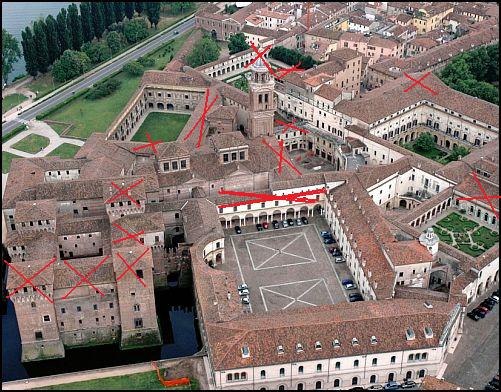
PALAZZO DUCALE: LISTA DEI DANNI - MAIN DAMAGES

Immagine elaborata dal Dr. Lorenzo Bonoldi
EMERGENZA SISMA 2012

RILEVAMENTO STATO DEI DANNI DI PALAZZO DUCALE

Dal sito della Soprintendenza: www.mantovaducale.beniculturali.it

Corte Nuova
  • la Galleria della Mostra, la Sala dei Mesi già interessate da crepe dovute alle scosse del 20 maggio ora presentano ampie fessurazioni nelle volte, con caduta di intonaco e degli elementi decorativo plastici; 
  • anche la Sala di Manto è interessata da cadute diffuse di intonaco. 


Castello
  • Camera degli Sposi, di Andrea Mantegna, cadute sulla parete della Corte, zona centrale, nella porzione di cielo, riapertura di una crepa sottile preesistente, con relativi sollevamenti di stucchi; 
  • Sala delle Sigle: apertura di crepe nella volta, in corrispondenza della sala degli affreschi si è creata una grande fessurazione; 
  • Carceri di Belfiore: presentano notevoli criticità con danni notevoli alle strutture murarie e alle volte; 
  • Torre del Castello: rottura dei mattoni sovrastanti la finestra, verso piazza Castello; 


Camini di Piazza Castello
  • si è verificata la loro stabilità e si provvede alla fasciatura per scongiurare la caduta; 


Basilica di Santa Barbara
  • la scossa del 29.05.2012, ore 12.57, ha provocato la caduta del lanternino della Basilica di Santa Barbara, già spostata con la scossa delle ore 9.01, in parte i materiali sono caduti sulla balaustra della loggia di Santa Barbara e hanno sfondato il tetto in corrispondenza delle stanze adiacenti l'Appartamento delle Metamorfosi.; 


Scala di Manto
  • grave dissesto dei muri in corrispondenza delle finestre; 


Sala dei Fiumi
  • piccole cadute diffuse;


Appartamento di Vincenzo I
  • parete esterna verso piazza Paccagnini, dissesto delle finestre;


EARTHQUAKE IN MANTUA
A LIST OF THE MAIN DAMAGES IN THE DUCAL PALACE
English version by Dr. Lorenzo Bonoldi

CASTLE OF SAN GIORGIO 
  • Bridal Chamber by Mantegna (“Camera degli Sposi”, aka “Camera Picta”: a long crack appeared on the wall with portraits of the Gonzaga family; some of pieces of frescoed plaster have fallen down. 
  • Chamber of the Initials: opening of cracks in the frescoed ceiling. 
  • Chamber of the Friezes: large and worrying cracks. 
  • More generally, severe damages to the supporting wall structures: break and fall of bricks in correspondence of the windows. Break of the footbridges behind the crenellation of the towers. 


NEW COURT 
  • Hall of Manto: Fall of frescoed plasters, large cracks in the frescoes, dislocation of the coffered wooden ceiling (the largest in Mantua). 
  • Staircase of Aeneas (connection between the New Court and the Castle): severe dislocating cracks of the walls. 
  • Gallery of the Marbles (aka Gallery of the Months): severe falls of plaster and painted stuccoes. Collapse of a part of the moulding cornice. 
  • Gallery of the Exhibition: many cracks. The Gallery is also threatened by the unstable dome of the of near Bell-tower of the Basilica of Santa Barbara (Church of the Palace), which is likely to collapse, breaking through the ceiling. 
  • Nova Domus: a crack in the outer (supporting) wall in correspondence of one of two terraces overlooking the Garden of the Simples. 
  • Corridor of Bertani: unstable ceiling (somewhere collapsing). 
  • Corridor of Paolo Pozzo: collapse of a part of the marble balustrade on the roof of the passage.


PALATINE BASILICA OF SANTA BARBARA (Private Church of the Gonzagas)  
  • Collapse of the lantern of the bell-tower (destroyed). 
  • Unstable dome of the bell-tower. 
  • Damage to the façade. 
  • An angular crack on one of the Cubes (square domes) of the Church. 


OLD COURT 
  • Hall of the Rivers: widespread falls of frescoed plaster. 
  • Ducal Flat: tipping of a wall to the outside, with danger of collapse on the beneath Paccagnini Square; dislocation of the windows. 
  • Chamber of Pisanello: failure of one of the rafters.
Galleria della Mostra - Gallery of the Exhibition


Terremoto a Mantova - Erdbeben - Earthquake

Mantua Mantova Guide Turistiche, Führungen, Guided Tours, Guida turistica di Mantova, Toutist guide Mantua,

Col sisma del 20 maggio scorso, il Palazzo Ducale era stato chiuso e successivamente parzialmente riaperto al pubblico, ma con le ultime tre scosse del 29 maggio, la lanterna del campanile della basilica palatina di Santa Barbara in Palazzo Ducale è crollata.
La chiesa di Santa Barbara, tempio perfetto, era stata commissionata dai duchi Guglielmo Gonzaga ed Eleonora d’Asburgo e quindi edificata – tra il 1562 ed il 1572 – dall’architetto Giovanni Battista Bertani.
Il campanile di Santa Barbara di era uno dei tratti distintivi del magico profilo di Mantova, che si poteva ammirare dal Lago Inferiore, provenendo da Nord-Est.
La scossa delle 12:55 del 29 maggio è stata quella che ha fatto crollare definitivamente la lanterna del campanile, che si era già inclinata con quella delle 9:00.
Parecchi problemi anche nelle stanze del palazzo, alcune delle quali erano state da poco riaperte dopo il sisma del 20 maggio. 
Se la Camera degli Sposi di Andrea Mantegna non dovrebbe aver subito danni, almeno secondo il conservatore del Palazzo, in altre zone della Reggia le cose sono andate decisamente peggio.
In particolare è stata gravemente danneggiata la Sala di Manto, dove si sono aperte nuove crepe. Inoltre sulla torre centrale del castello di San Giorgio è comparsa una vistosa fessurazione, mentre il tetto dell’esedra di piazza Castello si è imbarcato pericolosamente.
Per quanto riguarda Palazzo Te, a subire i danneggiamenti più gravi è stata la parte nord della villa giuliesca: crepe, caduta di intonaci e di colore dagli affreschi, peggioramento di fessurazioni già esistenti si sono verificati nella loggia delle Muse e nella sala di Amore e Psiche. La celebre Sala dei Giganti non ha subito danni all’interno, mentre una vistosa crepa si è aperta sul muro esterno. 
Tutto il centro storico è incerottato e spuntano transenne un po’ dappertutto. La scossa delle 13 ha fatto crollare un camino dal Palazzo del Podestà, mentre una frattura si è aperta internamente ed esternamente nella torre della Casa del Mercante, un edificio duecentesco che dà sulla centralissima piazza Mantegna, quasi di fronte alla Basilica di Sant’Andrea.


ERDBEBEN IN MANTUA

Die Provinz und die Stadt Mantua wurden durch die Serie von dem Erdbeben in Norditalien, zwischen den 20. und 29. Mai weitgehend beschädigt.
Auch der Schaden am Kulturerbe der Region ist immens. Viele historische Gebäude stürzten ein, alte Kirchen wurden zerstört; der Palazzo Ducale in Mantua und der Palazzo Te bekamen Risse. Allein in Mantua und Umgebung sind nach den Erdbeben von 300 Kirchen etwa 100 beschädigt oder eingestürzt.
Im Herzogspalast die größten Schäden: die Laterne des Glockenturmes der Kirche Santa Barbara ist mit dem Erdstoß des 29. Mai um 12.55 Uhr gefallen.
Die Hofkirche Santa Barbara wurde von 1562-1572 nach einem Plan des Architekten Giovanni Battista Bertani für den Herzog Guglielmo Gonzaga und seine Frau Eleonore von Österreich gebaut.
Der Glockenturm der Kirche Santa Barbara, mit der eleganten Laterne, war ein der Symbolen des märchenhaftes Skyline der Stadt Mantua.
Der Bürgermeister von Mantua und die Direktoren der Museen von Palazzo Ducale und Palazzo Te haben das Schließen der Paläste beschlossen: Einstürze von Putz, Stuckwerke und Farben der Freske, aber auch Spaltungen in den Mauern.


EARTHQUAKE IN MANTUA

With the earthquake of May 20th the Ducal Palace had been closed and later reopened, but after the last three shocks of May 29th, the lantern of the bell-tower of the Palatine Basilica of Santa Barbara, the Palace Church for the Gonzagas, has collapsed. 
The Palatine Church of Santa Barbara was commissioned by the Duke Guglielmo Gonzaga, for the birth of his first son Vincenzo, and built between 1562 and 1572 by Giovan Battista Bertani.
This bell-tower, with its lantern, was one of the landmarks of the romantic skyline of the town.
Always in the same day, the Mayor of Mantua and the Director of Palazzo Te have checked through the Museum: falls of rubbles, of stuccoes and of frescoed plaster and also vertical cracks in the North Wing: the Loggia of the Muses, the Exterior Loggia, the Hall of the Horses and the Chamber of Cupid and Psyche have been damaged.
Due to the earthquake both the Ducal Palace and Palazzo Te are closed indefinitely.

La foto del crollo, scattata martedì 29 maggio 2012 alle ore 12.55,
è del fotografo della Gazzetta di Mantova Mirko Di Gangi.


Vincenzo Gonzaga - Il fasto del potere


MUSEO DIOCESANO "FRANCESCO GONZAGA"
18 FEBBRAIO - 10 GIUGNO 2012

Una mostra raffinata, che rivela la figura di VINCENZO I GONZAGA (1562-1612), splendido principe delle corti d’Europa, che portò il ducato di Mantova a diventare un importante centro d’arte e la cui corte si misurava per sfarzo con quelle dei grandi regni europei e italiani. 
Vincenzo, il sovrano che ebbe per sé poeti come Torquato Tasso, musici quali Claudio Monteverdi e pittori della grandezza di Rubens. 
I quadri e le opere esposti in mostra evocano la magnificenza della corte. Ma anche i vincoli di sangue che legarono Vincenzo, che aveva sposato in seconde nozze Eleonora de’ Medici, alla casa d’Austria (la mamma era l’arciduchessa d’Austria Eleonora d’Asburgo ed i nonni materni erano l’imperatore Ferdinando I ed Anna Jagellone, regina d’Ungheria e Boemia) ed alla Francia, poiché re Enrico IV di Borbone era suo cognato, agli Este ed ai Savoia, senza dimenticare che la figlia Eleonora diventò imperatrice, sposando Ferdinando II d’Asburgo. Il Vincenzo del fasto e del potere appunto. 
Il duca che istituì un ordine cavalleresco tra i principali d’Europa, l’Ordine Militare del Sangue di Gesù Cristo, commissionò architetture imponenti e animò la reggia con spettacoli sontuosi. Un libertino, come si diceva, ma anche un uomo di fede, fortemente legato al cugino, il beato (e successivamente santo) Luigi Gonzaga. 
Al Museo Diocesano ‘Francesco Gonzaga’ 80 opere, tra gioielli, dipinti, armature, incisioni, tessuti, per lo più inediti, delineeranno la figura di Vincenzo I Gonzaga, IV duca di Mantova e II duca del Monferrato, dal 1587 al 1612. 
L’esposizione ha una preziosa appendice nella reggia di Palazzo Ducale che, per l’occasione, apre tutti gli ambienti dell’appartamento ducale di Vincenzo. 

DIOCESAN MUSEUM "FRANCESCO GONZAGA"
18 FEBRUARY - 10 JUNE 2012

A very refined exhibition that reveals the figure of VINCENZO GONZAGA IV DUKE OF MANTUA AND II DUKE OF MONFERRAT (1562-1612), an European brilliant prince, who turned Mantua into a vibrant cultural centre. His court was not less gorgeous than all the other European courts. 
Vincenzo was a major patron of the arts and sciences; he employed the composer Claudio Monteverdi and the painter Peter Paul Rubens as well as the poet Torquato Tasso. 
The canvas and objects displayed at the exhibition evoke the splendour of Vincenzo’s court. But also the relationship with the main European courts: his mother was the Emperor's daughter Archduchess Eleanor of Austria and his maternal grandparents were Ferdinand I, Holy Roman Emperor and Anna of Bohemia and Hungary. Vincenzo married Eleonora de' Medici, the dynasty ruling over Florence and in this way the king of France, Henry IV of the House of Bourbon, was his brother-in-law (he married Eleonor’s sister Maria de’ Medici). One of Vincenzo’s daughters, Eleonora, became then Empress when she married Ferdinand II, Holy Roman Emperor. The splendor of power. 
The pomp of the court. 
Vincenzo was the duke who instituted the Blood of Jesus Christ Military Order, one of the most important in Europe and who built imposing architectures around Mantua. An impenitent libertine, but also a man of faith, who was really bound to his cousin (Saint) Aloysius Gonzaga. 
At the Diocesan Museum “Francesco Gonzaga” 80 works, such as jewels, paintings, armours, engravings, books, lettres, fabrics, often only known by specialists will illustrate the age of Vincenzo Gonzaga, duke from 1587 to 1612. 
The visit to Vincenzo's apartments in the Ducal Palace is another great opportunity to know and understand the Duke.

Vincenzo Gonzaga nel giorno dell'incoronazione a duca


Vedi anche, sehen Sie auch, see also

MUSEO DEI VIGILI DEL FUOCO - FIRE BRIGADE HISTORICAL MUSEUM


IGNIS - FOCUS > FUOCO - FIUR > FEUER - FIRE

Il Museo dei Vigili del Fuoco si sviluppa su una superficie di circa 1500 m2, è costituito da quattro vaste sale, collegate tra loro da grandi aperture ad arco e vi sono raccolti mezzi ed attrezzature dal XVIII al XX secolo.
Si tratta di una raccolta di indubbio interesse, poiché testimonia l’evoluzione tecnica dei mezzi dei Vigili del Fuoco in questi secoli.
Nella prima sala (le antiche scuderie della famiglia Gonzaga) si trovano i mezzi più antichi: pompe azionate e trainate a mano o da cavalli, una lettiga della fine dell'Ottocento ed il primo modello di scala aerea. Quindi una  pompa a vapore Merry Weather ed una scala aerea Magirus. Nella seconda sala trovano collocazione mezzi dal 1920 al 1940: tra gli altri l'autopompa di costruzione americana Seagrave Continental, la FIAT 502, l'autocarro attrezzato FIAT 605 e l'autobotte FIAT 621P. La terza sala ospita i pezzi più imponenti tra cui l'OM Loc, l'APS FIAT 626 e relativa autoscala, un anfibio GMC ed uno Schwimmwagen, il sidecar Gilera VLE ed alcune moto Guzzi. Al centro della quarta sala è esposto l'elicottero Augusta Bell 47 G 3B-1, attorno al quale, in una serie di vetrine, sono esposte uniformi ed elmetti di varie epoche e provenienze.

The Fire Brigade Historical Museum has got a surface of 16,147 SqFt and it is divided into four huge halls, linked together by large open arches. It collects vehicles and mementoes from the 18th to the 20th century, showing the remarkable technical evolution of the means of transport used by the Fire Brigade Corps along these centuries.
The first room (the old ducal stables) shows the most ancient means: the first volumetric pumps, which were operated and drugged, by hand or by horses; a litter  of the 19th century and the Door-Ladder, the first model of aerial ladder. Wonderful Merry Weather steam pump stands out as well as a Magirus aerial ladder. Vehicles dated form 1920 to 1940 are displayed in the second hall: the  Seagrave Continental fire engine vehicle of American construction,  FIAT 502 and FIAT 605 equipped tracks and the FIAT 621P tank truck. In the third hall there are the most imposing means: among them the OM Loc, the APS FIAT 626 and its motor ladder, also GMC and a Schwimmwagen amphibious, a Gilera VLE sidecar  and some  Guzzi motor-cycles. Right in the centre of the fourth hall, the G 3B-1 47 Bell Augusta helicopter and around it  - in some large glass show-cases -  a collection of uniforms and helmets from different ages and countries.

Foto di Massimo Pavan

Foto di Massimo Pavan

Foto di Massimo Pavan

Foto di Massimo Pavan


Vedi anche - Sehen sie auch - See also

PIETER PAUL RUBENS


"La famiglia Gonzaga in adorazione della SS. Trinità" P.P. Rubens (1604-1605)
Dell'imponente opera, consegnata da Pieter Paul Rubens alla Chiesa della Trinità nel 1605, rimane a Mantova solo la scena centrale, poiché i due dipinti posti ai lati sono stati rimossi durante la dominazione napoleonica, tra il 1797 ed il 1801: la Trasfigurazione di Cristo si trova al Museée des Beaux Arts di Nancy, mentre il Battesimo di Cristo è ad Anversa al Museum voor Schone Kunsten. Nel 1801 anche la scena centrale della Trinità venne sezionata, nel tentativo di trasportarla nel neonato Museo di Brera, ma la comunità mantovana riuscì a salvarla e ad evitare il trasporto a Milano. Attualmente la tela ha un aspetto frammentario, dovuto ad antichi restauri.
Al centro dell’ampia composizione il committente dell’opera, il Duca Vincenzo I Gonzaga, alla sua sinistra il defunto padre Guglielmo, mentre a destra le rispettive consorti, le Duchesse Eleonora de’ Medici ed Eleonora d’Asburgo.
Rubens aveva ritratto alle spalle di Vincenzo due alabardieri ed i tre figli maschi: Francesco IV (collezione privata di Mantova), Ferdinando (Fondazione Magnani Rocca di Traversetolo), Vincenzo II (Kunsthistorisches Museum, Vienna). Alle spalle di Eleonora de’ Medici erano state invece ritratte le due figlie: Margherita (già collezione Burchard di Londra) ed Eleonora (ritratto perduto, di cui resta a Palazzo Ducale una porzione raffigurante una mano che accarezza un cagnolino), attorniate da almeno tre alabardieri, tra i quali, pare che Rubens si fosse ritratto. Vi interessa saperne di più ed essere accompagnati da una guida turistica?

Man kann von einer echten Überraschung sprechen, wen man dieses Meisterwerk des Flamens Pieter Paul Rubens sieht. 1605 wurde die Altartafel für die Jesuitenkirche der Santissima Trinità realisiert; nur der große mittlere Teil ist in Mantua geblieben, denn die beiden seitlich angebrachten Begleitgemälde wurden, zwischen 1797 und 1801 unter napoleonischer Herrschaft, entfernt. Die Verklärung Christi ist jetzt im Museée des Beaux Arts von Nancy und die Taufe Christi ist im Museum voor Schone Kunsten von Antwerpen. Es gab Versuche, auch das zentrale Bild in Stücke zu schneiden und abzutransportieren, aber der Gemeinde Mantuas gelang es schließlich, das Bild zu retten und auch den Transport nach Mailand zu verhinder, wo es im neu entstandenen Museum der Brera ausgestellt sollte. Die Leinwand besteht heute aus Fragmenten, denn während den frühen Restaurierungsversuchen wurden einzelne Leinwandteile unpassend  zusammengefügt, während andere an ausländische und private  Sammler gingen.
Im Zentrum der riesengroßen Komposition, die wir uns ursprünglich noch großartiger vorstellen müssen, steht die Familie Gonzaga: links der Auftraggeber des Bildes Herzog Vincenzo I Gonzaga und sein Vater Guglielmo, während rechts die Ehefrauen Eleonora de’ Medici und Eleonora von Habsburg.
Rubens hatte auch die Kinder von Vincenzo I und Eleonora bemalt: links von Vincenzo waren Francesco IV (private Sammlung in Mantua), Ferdinando (Fondazione Magnani Rocca di Traversetolo), Vincenzo II (Kunsthistorisches Museum, Wien). Hinten Eleonora de’ Medici waren die Töchter Margherita (schon in der  Burchard Sammlung aus London) und Eleonora (das Porträt ist verloren, aber es bleibt, im Herzogspalast, ein Teil ihrer Hand mit einem Hündchen); um die Figuren gab es mindestens drei Hellebardiere, unten denen – vielleicht – Rubens selbst. Sind Sie interessiert etwas mehr, zu wissen, um die Stadt mit einer geprüften Fremdenführerin Mantuas zu besichtigen?

It’s a genuine masterpiece the canvas by the Flemish painter Pieter Paul Rubens. This altarpiece was delivered to the Jesuit church of the Hoy Trinity in 1605. Only the enormous central canvas has remained in Mantua, as the paintings that were on both sides were removed, under the rule of Napoleon, between 1797 and 1801. The Transfiguration of Christ is now in Museée des Beaux Arts in Nancy, while the Baptism of Christ is in Museum voor Schone Kunsten in Antwerp. An attempt was made to carry off the central piece as well, by cutting it into several pieces, but in the end the Mantuan community was able to save it from being taken to Milan, where it had been requested for the newly opened Brera Museum. The canvas now has a fragmentary appearance due to old restorations, when the picture was dismembered and some of the portraits were cut out and made up into rectangles for reaching later foreign and private collections. Finally, some other pieces of the canvas had been joined together incongruosly.
At the centre of the huge composition is set the Gonzaga family, represented on the left by the client the Duke Vincenzo I Gonzaga and his father Guglielmo, already dead  when the picture was painted, while on the right are their respective wives the Duchess Eleonora de’ Medici and Eleanor of Austria.
Rubens portrayed also Vincenzo’s children: on his left Francesco IV (private collection in Mantua), Ferdinando (Fondazione Magnani Rocca di Traversetolo), Vincenzo II (Kunsthistorisches Museum, Vienna). Behind Eleonora de’ Medici there were the two daughters Margherita (still in the Burchard Collection of London) and Eleonora (whose portrait is lost while in Mantua there is only a small part of it, showing Eleanor’s hand stroking a puppy). Around the ladies, at least three halberdiers, one of which is (probably) Rubens' self-portrait. Want to know more


Vincenzo II Gonzaga (Kunsthistorisches Museum in Wien)

Francesco IV Gonzaga (Collezione privata Mantova)


Margherita Gonzaga (già collezione Burchard, Londra)